In November 2024, I had written about AI and its interface with law. Much has changed in the preceding year and a half. Following is the memoire of a practising lawyer before the AI overlords took over.
There was a very distinct tonality and punctuation to AI writing when I wrote the previous post and I certainly took pride in easily pointing out to peers, juniors and family members what was AI-generated and what was not. My measure of AI writing’s progress is simply my advancing inability to judge what is AI generated and what is not. As of today, I am no longer confident in my ability to distinguish AI-generated text from human writing. I second guess whether the text is AI generated or my colleague has really developed a knack for flawless writing and structure.
The capability is certainly enhanced. Even when it comes to research, hallucinations are slowly going away. The cases do say things that the chatbot is describing.
Don’t get me wrong. We lawyers are not out of jobs yet. There are mistakes, tell-tale signs of over-embellishment in prose, contrary understanding of judgments and sometimes brazen concoction of citations with absolute confidence by the AI chatbots.
Specialized tools like Harvey and Legora are being marketed to law firms and are being adopted quickly as no firm wants to be lagging in the AI rat race. Understandably so. Please refer to this 2024 dataset by Bloomberg which highlights key areas where Gen AI is being used by lawyers –
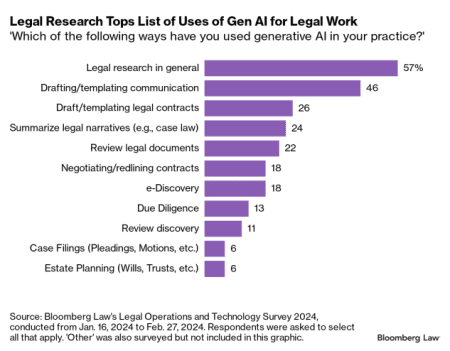
It can be safely extrapolated that this number has certainly increased over the course of around 2 years.
Research
There is no doubt that the AI tools have helped reduce the overhead associated with research and first drafts for many lawyers and firms. For example, earlier searching through judgment databases such as SCCOnline, Manupatra, Indiankanoon etc. required a basic skillset like putting the right keywords, removing prepositions and scouring through pages and pages of judgments to find that one judgment which might turn the tide in your favour in a courtroom battle. Nowadays, search is really accessible even with natural language. For example, you may simply type “judgments of Delhi High Court and Supreme Court dismissing suit for non-joinder of necessary parties” and you’ll get a list of various judgments with concise summaries and a brief analysis of their applicability. This is legal accessibility for sure.
During my own experience with chatbots like Chatgpt, Gemini and Claude, hallucination and fabrication of fake citations and sources can be significantly curbed by additional prompts such as “do not refer to or cite any judgment without first verifying the proposition from source.” This, in my experience, reduces false and inaccurate references and conclusions in research.
Drafting
Another aspect where AI chatbots are encroaching on lawyers’ domain is drafting. Having access to the entire world wide web and the ability to instantaneously find relevant information does come in handy for the chatbots. There is still a significant gap between what is rendered by a chatbot and a watertight professional draft. This is not unusual, because high quality drafts by practicing attorneys would rarely be uploaded on the world wide web and openly accessible. This naturally creates a limitation in the training data available to chatbots.
Presently, the chatbot drafts can be used for creating bare drafts of simpler applications or petitions which provide a basic structure on which a human can work with his or her own expertise.
Searching through case documents
One of the best use cases of chatbots and legal software is their natural language search capability. Often times, you may require looking up a very specific fact in a pile of documents running into thousands of pages. In earlier times, this may require you to open files and then use search function to find the words that may correlate with what you are looking for. Tedious, chance based and tiring. In contrast, once documents are uploaded to the servers of the chatbot or the legal software, all you need is just a natural language query and it’ll likely give you the precise document and page number required.
For example, you may recall that during the cross examination that happened two years ago, you did get a few admissions or contradictions from the opposition’s witness. However, the cross examination may run into hundreds of pages. With the above method, you may get a list of all potential admissions and contradictions within 30 seconds. This really comes in handy before strategy meetings with clients when your schedule hasn’t permitted you to go through the record in detail.
Obvious downsides
The most obvious concern is job security. A person enrolling in law school today will be wondering will there be a job to do in 10 years or so. Many routine programming tasks are increasingly being automated. Customer service representatives are increasingly being replaced by bots, much to the frustration of consumers.
As doctors would know better, having easy access to half knowledge makes clients really hard to deal with. In an ideal world, a client will trust the subject matter expert like doctors, engineers and lawyers. This is usually due to two factors, understanding that years of experience counts for something and not having access to all the knowledge sources themselves. Now the second factor is gone. Chatbots are basically search engines on steroids with correct-sounding opinions. And add to that the knack of Chatbots to agree with the user in order to make them happy. This is certainly a potent combination.
Case in hand. I am sitting in front of a Senior Counsel we are briefing in a trademark dispute before the Supreme Court of India. We are trying our best to explain the few silver linings that may help us sail through the blatant infringement my client has been alleged to be guilty of. The Counsel is deliberating on the wafer thin defences that we had been able to work out after burning the midnight oil. Suddenly, I felt a tap on my shoulder. The Client is animatedly showing me his phone screen. He said there was a judgment on the issue and gestured for me to show it to the Counsel. I glanced at the case, it was the Nandini v Nandhini dispute [M/S. Nandhini Deluxe vs M/S. Karnataka Cooperative Milk 2018 (9) SCC 183]. He emphasized how both brand names were allowed to exist despite the fact that both parties sold milk. I checked his phone, it was Claude telling the client that Nandhini and Nandini both sold milk and yet allowed to co-exist. Having read the case long back, I knew Nandhini was a restaurant and Nandini was a milk brand. In a hushed tone, I told the client that we were aware of the judgment and that Nandhini was a restaurant. But the client insisted that both were milk brands as he has read on Claude. He felt I didn’t present the ‘perfect’ judgment before the Counsel. After the conference, I had to show the exact judgment and explain how the AI generated summary was wrong. I am still not sure the client is convinced.
Another time a client facing demolition seemed to have a grievance for not having taken certain grounds regarding gaushalas or religious places having protection of laws. The client, again in a conference with a Senior Counsel told the counsel that he has himself researched how there are laws which protect gaushalas and religious places from demolition. He proudly added that he has done all of that overnight … through Artificial Intelligence. I had done my research and told the meeting that there is a stray provision in Rajasthan but none in Delhi regarding gaushalas and there is no prohibition on demolition of religious structures. The client again, felt we didn’t take the points he had given.
Therefore, there is an increasing anxiety and dissatisfaction with a lawyer’s work when the knowledge barrier has been breached. The easy access to information, albeit false at times, has led to increased scrutiny of a lawyer’s work.
Further, call me pessimistic but I see a future where businesses are more or less automated. Similar to how telecom, software and business standards have necessarily converged on standards and interoperability for the sake of efficiency and necessity, if one significant industry is largely automated, the others will have to follow suit, especially if it comes with a cost benefit. When businesses and transactions are automated, the data becomes streamlined, disputes may become significantly less frequent. As usual, majority of disputes concern payment of money in one way or another, systems that can talk to each other, provided there is a universal sanctity to them, will be able to resolve or alleviate any mismatch or disagreement. Further, even in cases of disputes, they can be resolved by an automated process since data i.e. evidence, will be available in an objectively assessable format. The human element i.e. the lawyers, the judges, the arbitrators, etc. may be phased out.
The above is extreme cynicism, but one which is not out of the realm of possibilities. Today, we are all forced to adapt to a rapidly changing world. I see that in the small time vendors’ advertisement boards, the e-vites, the cover letters, the congratulatory messages. All generated with AI.
On the argument of whether there can be guardrails on the extent to which AI can be imposed upon the masses, there is nothing much that can be done. We are governed by a capitalistic system that values the bottom line over anything else. The moment AI-assisted programming became commercially viable, significant layoffs in parts of the software sector followed. Meta recently laid off 8000 people representing around 10% of its workforce.
Arguments based on the necessity of human connection, morality, and ethics within the judicial system will struggle to compete when it competes with a profitable bottom line for the corporate decision makers who will invariably choose short term profits for shareholders over long term impact on humanity. We would be fooling ourselves to believe that governments will protect the larger interest when it becomes a choice between employment of masses or profit of few. After all, these profits fund the governments and the leaders. These profits can buy off mass media which can help curb any dissent. Life goes on. Or does it?
[The above image is AI generated – another area which has seen significant change]